I Asked AI to help me Build a Moodle Plugin
Section outline
-
Important Note: If you arrived here after watching my video about building five Moodle plugins with AI, you are in the right place. This mini-course lets you experience those five plugins as a learner and see how they can be adapted for different purposes.
For this demonstration, I have applied them to a discovery journey for Creator Entrepreneurs — people exploring the audiences they might serve through content, courses, consulting or other forms of online work. This is simply one practical example. The same five frameworks could just as easily be adapted to almost any vocational, educational or personal-development context.
At first glance, the focus of the course may appear to be the five bespoke Moodle plugins used to create the reflection activities. But there is a deeper idea behind them.
These plugins demonstrate that a Moodle activity does not have to be built around one fixed questionnaire or one predetermined assessment. A bespoke plugin can provide a framework for creating many different self-reflection instruments, with the subject matter, questions, categories, dimensions and interpretations changed to suit a particular purpose.
AI makes this dramatically easier. Instead of manually building every new reflection instrument, an educator can describe what learners should reflect on and use AI to generate much of the required content and, where applicable, the JSON that defines the instrument.
There is an even broader lesson. The real significance may not be these five plugins at all. They are examples of what has become possible: with AI assistance, educators who can clearly describe a learning need can increasingly participate in designing and creating Moodle tools that previously would have required specialist software-development skills.
The five plugins explored in this course are SelfProfile (which, with hindsight, I rather wish I had called SelfFinder), PassionFinder, SkillsFinder, PersonalityFinder and ExperienceFinder.
Together they are used here to explore Creator Entrepreneurship, but the underlying frameworks could be adapted to support reflection around many different vocational directions, learning journeys and development contexts.
SelfProfile in a nutshell...PassionFinder in a nutshell...SkillsFinder in a nutshell...PersonalityFinder in a nutshell...ExperienceFinder in a nutshell...Reflects on who I amReflects on what draws meReflects on what I can doReflects on how I tend to operateReflects on what my experience revealsLikert-scale statementsBest–Worst choicesCompetency selection & ratingAttributes & bipolar dimensionsExperience & guided reflectionMeasures agreementReveals preferencesMeasures perceived competenceReveals personality preferencesIdentifies recurring patterns"This describes me.""I am drawn to this more than that.""I can do this well.""This is how I tend to operate.""My life provides evidence of this."
Discover Your Creator Direction
Helping you discover the audience you are uniquely equipped to serve
Welcome
Every successful Creator Entrepreneur has one thing in common. They consistently improve the lives of a particular group of people. Some teach, some entertain, some inspire, some solve practical problems, some build communities, some create tools.
The most successful creators are rarely those who chase the latest trend. Instead, they build trust over time by consistently helping a clearly defined audience. They certainly shouldn't chase money. I think money follows people.
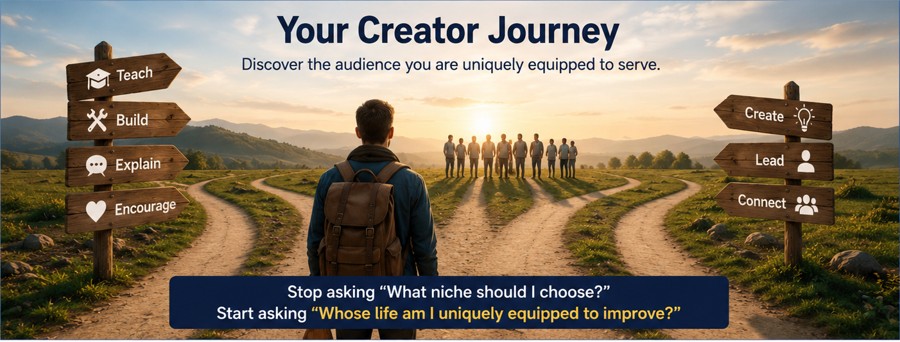
The challenge is that many aspiring creators begin with the wrong question.
"What niche should I choose?"
That question usually leads people to copy someone else's success.
A better question is:
"Whose life am I uniquely equipped to improve?"
That is the question this course will help you explore.
This is not a personality test
This mini-course is not designed to tell you what career you should pursue. It is not a psychometric assessment. It will not predict your future (you probably know it subconsciously already...).
Instead, it will guide you through five structured self-reflection activities that help you gather evidence about yourself and get your powerful subconscious to work. As you work through the activities, you will reflect on
-
your natural abilities
-
the topics that energise you
-
the skills you have developed
-
your preferred way of working
-
the experiences that have shaped your life
No single activity provides the answer. Together, they begin to reveal patterns. Those patterns often point toward audiences you may be particularly well equipped to serve.
Think like a detective
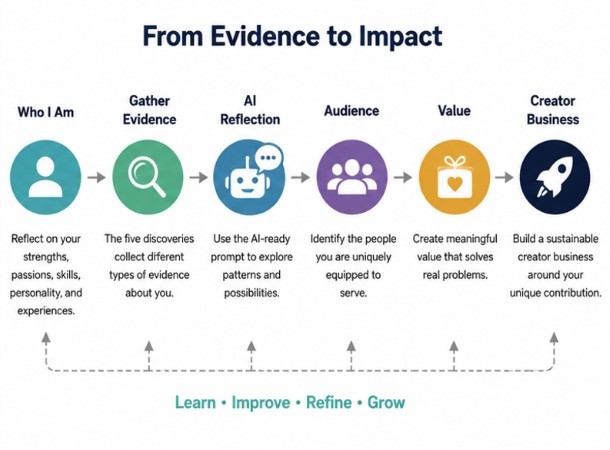
Imagine trying to solve a mystery. A detective doesn't rely on one clue. They gather many independent pieces of evidence, and then they connect the dots. The same is true when discovering your creator direction.
Each activity collects one type of evidence. Only when all five are considered together does a clearer picture begin to emerge.
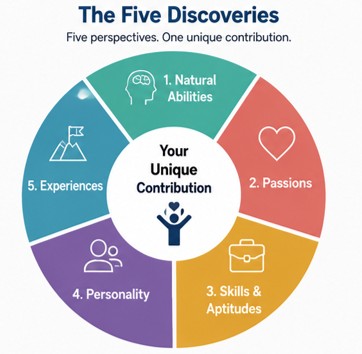
The Five Discoveries
1. 🧠Natural Abilities
What comes naturally to you? What do other people notice about you? What abilities seem to require less effort than they do for others? Which ones are you prepared to develop further?
2. ❤️Passions
What problems disturb you? Which people naturally capture your attention? What subjects could you happily spend years learning and talking about?
3. 🛠Skills & Aptitudes
What have you learned? What competencies have you developed through work, study, hobbies and life? Which of those skills could genuinely help other people?
4. 🧭Personality
How do you naturally create value? Do you prefer explaining? Building systems? Connecting with people? Experimenting? Leading? Supporting? Teaching? Different personalities build successful creator businesses in different ways.
5. 📖Experience
Your life has already produced evidence. Your successes. Your failures. Your work. Your hobbies. Your relationships. Your projects. Your experiences often reveal patterns that no questionnaire could discover on its own.
What happens at the end?
When you complete all five activities, the evidence gathered throughout the course will be brought together into a structured summary. Each activity also gives a PDF document. You can upload the PDF documents to ChatGPT or another large language model.
Rather than asking AI to guess who you are, the prompt supplies it with rich evidence collected during your reflections.
Using that evidence, AI can help you explore questions such as:
-
What natural strengths appear repeatedly?
-
What motivates me?
-
What kinds of problems am I equipped to solve?
-
Which audiences may benefit most from my work?
-
Which creator directions appear most promising?
-
What business models may fit my strengths?
-
What experiments should I try next?
The goal is not for AI to tell you who you are. The goal is to help you interpret the evidence you have gathered about yourself.
JSON – The Secret Behind the Instruments
The reflection instruments described in this mini-Moodle course are largely powered by JSON (JavaScript Object Notation).
Don't let the name intimidate you. Think of JSON as a modern, structured version of a spreadsheet or comma-separated values (CSV) file. It is simply a way of storing information so that both people and computers can read and understand it.
Traditionally, creating a questionnaire or reflection instrument required entering every category and every question manually into Moodle. With these plugins, the entire instrument can be described in a single JSON file.
Even better, modern AI tools such as ChatGPT can generate these JSON files for you. Once you are happy with the wording, you simply import the JSON file into the appropriate plugin, and your instrument is created automatically.
Because JSON files contain only the instrument definition—not any student responses—they are ideal for sharing, reusing, backing up and improving instruments over time.
A small section of a JSON file looks like this:
{ "schema": "mod_selfprofile", "schemaVersion": 2,
"name": "Creator Entrepreneur Strengths",
"categories": [
{ "id": "communication",
"name": "Communication",
"statements": [
{ "text": "I naturally explain difficult ideas clearly.",
"scoringdirection": "normal" }
]
}
]
}Don't worry if JSON looks unfamiliar. Throughout this mini-course you will learn how AI can generate valid JSON instruments for you. Your role is not to write computer code—it is to decide what you want people to reflect on. AI and the plugins do the technical work; you provide the educational insight.
A Final Thought
Finding your direction is rarely a single moment of discovery. It is usually a process of observation, experimentation and refinement. This course won't hand you a perfect niche.
It will help you identify evidence-based directions worth exploring. From there, your audience will help you refine your path as you create, publish, listen and improve.
Your creator journey begins by asking a simple question:
Whose life am I uniquely equipped to improve?
-
-
SelfProfile in a nutshell... Reflects on who I am Likert-scale statements Measures agreement "This describes me." Activities: 1 -
SelfProfile in a nutshell... PassionFinder in a nutshell... Reflects on who I am Reflects on what draws me Likert-scale statements Best–Worst choices Measures agreement Reveals preferences through trade-offs "This describes me." "I am drawn to this more than that." Activities: 2 -
SelfProfile in a nutshell... PassionFinder in a nutshell... SkillsFinder in a nutshell... Reflects on who I am Reflects on what draws me Reflects on what I can do Likert-scale statements Best–Worst choices Competency selection & rating Measures agreement Reveals preferences Measures perceived competence "This describes me." "I am drawn to this more than that." "I can do this well." Activities: 2 -
SelfProfile in a nutshell... PassionFinder in a nutshell... SkillsFinder in a nutshell... PersonalityFinder in a nutshell... Reflects on who I am Reflects on what draws me Reflects on what I can do Reflects on how I tend to operate Likert-scale statements Best–Worst choices Competency selection & rating Attributes & bipolar dimensions Measures agreement Reveals preferences Measures perceived competence Reveals personality preferences "This describes me." "I am drawn to this more than that." "I can do this well." "This is how I tend to operate." Activities: 2 -
SelfProfile in a nutshell... PassionFinder in a nutshell... SkillsFinder in a nutshell... PersonalityFinder in a nutshell... ExperienceFinder in a nutshell... Reflects on who I am Reflects on what draws me Reflects on what I can do Reflects on how I tend to operate Reflects on what my experience reveals Likert-scale statements Best–Worst choices Competency selection & rating Attributes & bipolar dimensions Experience & guided reflection Measures agreement Reveals preferences Measures perceived competence Reveals personality preferences Identifies recurring patterns "This describes me." "I am drawn to this more than that." "I can do this well." "This is how I tend to operate." "My life provides evidence of this." Activities: 1 -
The Plugins contained here may also be found in the Moodle Marketplace. At the time of writing this, they may not all have been through the Moodle approval process, so use with care. (But, as you can see, they work well in this site...)
Activities: 1