PersonalityFinder
Lesson 4 — Meet PersonalityFinder
Estimated time: 20–25 minutes
Learning Outcomes
By the end of this lesson you will be able to:
- understand what PersonalityFinder is designed to do;
- understand the three sections of a PersonalityFinder instrument;
- understand semantic differential reflection;
- understand how two Focus Dimensions create a 2 × 2 personality matrix;
- create your first PersonalityFinder instrument;
- import and export PersonalityFinder JSON instruments;
- use AI to generate reusable PersonalityFinder JSON instruments;
- interpret PersonalityFinder results as reflective indications rather than fixed personality labels.
Section 1
What is PersonalityFinder?
PersonalityFinder helps respondents reflect on how they tend to relate, respond, decide, organise and contribute.
It is different from many familiar personality questionnaires because PersonalityFinder does not contain one built-in personality theory.
The teacher or activity creator decides what the instrument will explore.
For example, one PersonalityFinder instrument might explore:
- Task-oriented ↔ People-oriented
- Structured ↔ Unstructured
Another might explore:
- Analytical ↔ Relational
- Direct ↔ Diplomatic
Another could explore:
- Independent ↔ Collaborative
- Planned ↔ Adaptive
The labels, questions, dimensions, scales, result descriptions and quadrant names are therefore determined by the person who designs the instrument.
This makes PersonalityFinder useful in contexts such as:
- Creator Entrepreneurship
- career reflection
- leadership development
- church ministry reflection
- volunteer placement
- coaching
- mentoring
- team development
- educational reflection
PersonalityFinder is not a formal psychometric or diagnostic test.
Its purpose is to help people reflect on preferences and tendencies and provide a useful starting point for discussion.==================================
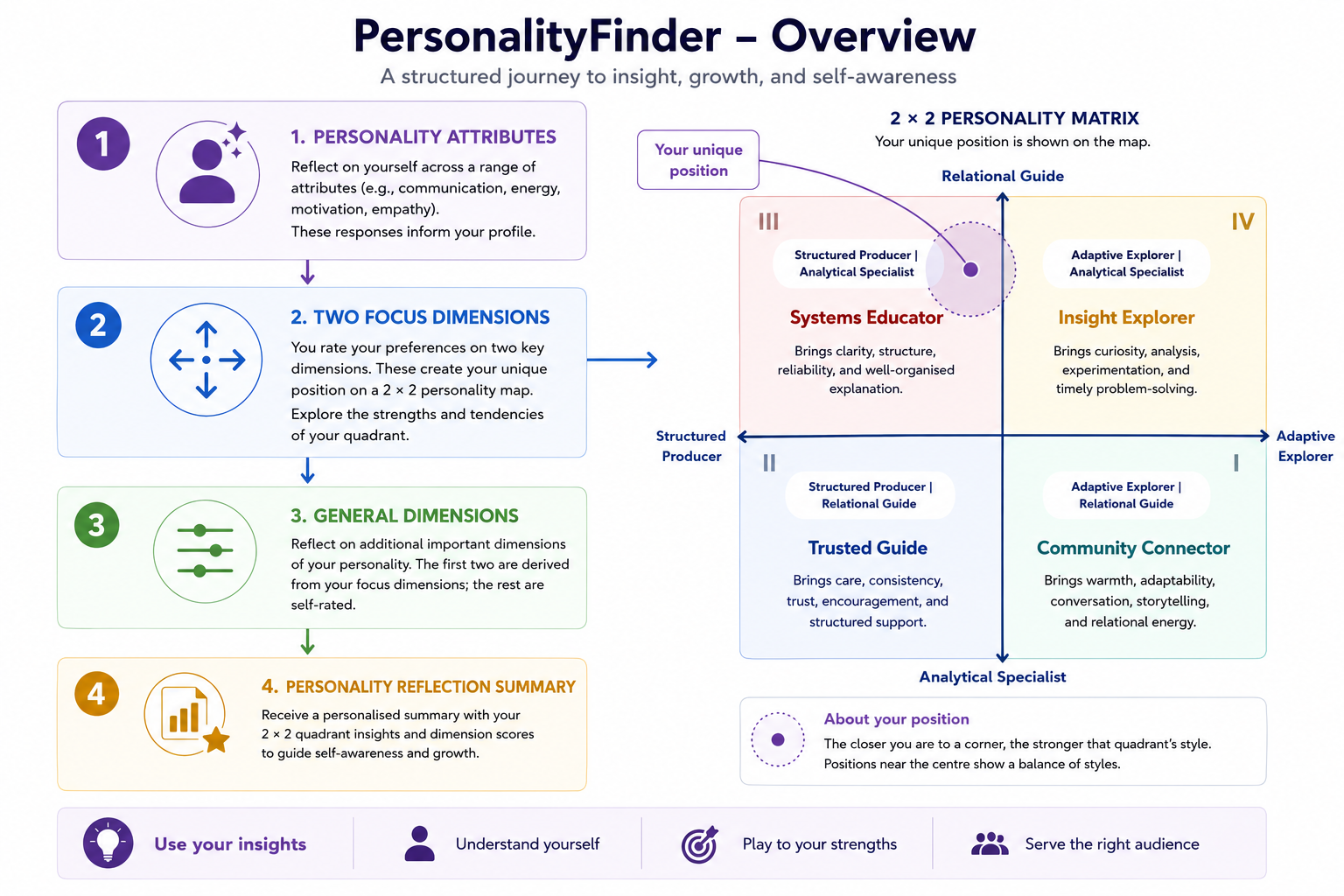
PersonalityFinder does not tell the respondent, "This is what you are." It provides structured information that helps the respondent ask, "Does this pattern describe how I tend to operate?"
Section 2
Installing PersonalityFinder
You can obtain PersonalityFinder in two ways.
Option 1
Download the latest version from Moodle.org.
Option 2
Download the plugin ZIP file from the Resources section of this course.
The Resources section also contains:
- README.md
- sample JSON instruments
- AI prompt templates
- demonstration reports
- future updates
Install the plugin in the normal Moodle way via:
Section 3
The Three Parts of PersonalityFinder
A PersonalityFinder instrument can combine three different kinds of reflection.
Part 1 — Personality Attributes
The respondent is shown a teacher-created list of descriptive words or attributes.
Examples might include:
- Courageous
- Steadfast
- Ordered
- Big-picture
- Talkative
- Gentle
- Analytical
- Encouraging
- Practical
- Creative
Depending on how the instrument is designed, respondents may reflect on:
"I describe myself this way."
and/or:
"Others may describe me this way."
This introduces an interesting distinction between self-perception and how we believe other people may experience us.
The purpose is not to calculate a formal personality score from these words. The selected attributes provide material for reflection.
Part 2 — Focus Dimensions
The second part explores exactly two main dimensions in greater depth.
For example:
Task-oriented ↔ People-oriented
and:
Structured ↔ Unstructured
These two dimensions are particularly important because they can later be combined to create the visual 2 × 2 matrix.
Part 3 — General Dimensions
The final part allows the teacher to include additional personality or behavioural dimensions.
For example:
- Reserved ↔ Expressive
- Independent ↔ Collaborative
- Cautious ↔ Bold
- Practical ↔ Conceptual
- Planned ↔ Spontaneous
- Detail-focused ↔ Big-picture
These dimensions broaden the reflection beyond the two dimensions used for the matrix.
The three sections do different jobs: attributes encourage recognition, Focus Dimensions explore two important contrasts in depth, and General Dimensions broaden the resulting personality reflection.
Section 4
Understanding Semantic Differential Reflection
The Focus Dimensions use a type of question known as a semantic differential.
Instead of asking:
"Do you agree that you are people-oriented?"
the respondent is presented with two contrasting statements.
For example:
I notice first what needs to be done.
↔
I notice first how people are feeling.
A scale appears between the two statements.
On a four-point scale it might look conceptually like this:
I notice first what needs to be done. 1 — 2 — 3 — 4 I notice first how people are feeling.
The respondent chooses the point that best represents their preference.
Another item exploring the same dimension might ask the respondent to choose between:
I feel satisfied when a task is completed well.
↔
I feel satisfied when people feel included and encouraged.
Several questions can therefore approach the same dimension from slightly different angles.
PersonalityFinder combines the responses to estimate where the respondent tends to lie between the two poles.
There does not have to be a "good" side and a "bad" side
This is an important principle when designing PersonalityFinder questions.
Consider:
Structured ↔ Unstructured
Neither end has to represent a weakness.
A person who prefers structure may bring order, consistency and preparation.
A person who prefers flexibility may bring adaptability, responsiveness and improvisation.
The purpose is to explore preference rather than reward the respondent for choosing one particular end of the scale.
Section 5
From Two Dimensions to a Personality Matrix
The most visually distinctive part of PersonalityFinder is the 2 × 2 matrix.
The matrix combines the respondent's result on the first Focus Dimension with the result on the second Focus Dimension.
Suppose an instrument uses:
Task-oriented ↔ People-oriented
and:
Structured ↔ Unstructured
One dimension can become the vertical axis and the other the horizontal axis.
The result is a matrix with four broad areas.
| Structured | Unstructured | |
| Task-oriented | Organiser / Implementer | Starter / Problem-solver |
| People-oriented | Shepherd / Facilitator | Connector / Encourager |
These quadrant names are examples only.
PersonalityFinder does not contain four permanent personality types called Organiser, Starter, Shepherd and Connector.
The activity creator defines:
- the two Focus Dimensions;
- the labels at each end of each dimension;
- the four quadrant names;
- the quadrant descriptions;
- the reflection text associated with each quadrant.
A completely different PersonalityFinder instrument could therefore use:
- Analytical ↔ Relational
- Direct ↔ Diplomatic
and create four entirely different quadrants.
Your result is a position, not a box
The respondent's result appears as a marker on the matrix.
This is more useful than simply assigning someone a four-letter type or placing them permanently into one category.
A respondent may appear strongly within one quadrant, close to the centre, or close to the border between two quadrants.
A position near the centre can itself be worth reflecting on. It may indicate that the respondent's preferences are relatively balanced or vary considerably according to the situation.
The quadrant provides language for reflection. It should not become a rigid box into which the respondent is placed.
Section 6
Building your first PersonalityFinder instrument
A PersonalityFinder instrument contains more elements than PassionFinder or SkillsFinder, but the basic structure remains manageable.
The main building blocks are:
- instrument title and description;
- reflection disclaimer;
- personality attributes;
- two Focus Dimensions;
- semantic differential items for each Focus Dimension;
- scale settings;
- four matrix quadrant definitions;
- General Dimensions;
- result interpretation text;
- reflection prompts.
Attributes
An attribute might look like this:
Steadfast
Reliable, loyal and consistent over time.
Focus Dimension
A Focus Dimension might be:
Task-oriented ↔ People-oriented
with several contrasting statement pairs used to explore the dimension.
Matrix Quadrant
A quadrant might be defined as:
Organiser / Implementer
You may naturally bring order, clarity, responsibility and follow-through.
General Dimension
An additional dimension might be:
Reserved ↔ Expressive
The activity creator can therefore design a PersonalityFinder instrument around the particular kind of reflection required in the course, coaching process, ministry setting or development programme.
Section 7
The real power of PersonalityFinder
As with the other Finder plugins, PersonalityFinder instruments can be created manually using the Instrument Builder.
They can also be imported and exported as JSON.
A complete PersonalityFinder JSON instrument can describe:
- instrument title;
- description and disclaimer;
- attributes;
- Focus Dimensions;
- semantic differential questions;
- scale settings;
- General Dimensions;
- matrix configuration;
- quadrant labels;
- quadrant descriptions;
- result interpretation text;
- reflection prompts;
- display settings;
- version information.
This means that a complete personality reflection instrument can be stored in a relatively small, human-readable text file.
The instrument can then be:
- shared with another teacher;
- imported into another Moodle course;
- adapted for a different audience;
- translated;
- edited in the Instrument Builder;
- used as a starting point for another instrument.
Section 8
AI-assisted Instrument Design
PersonalityFinder is particularly well suited to AI-assisted authoring because a complete instrument contains many related pieces of text.
Creating all of these manually could involve writing:
- dozens of attributes;
- two clearly defined Focus Dimensions;
- several contrasting statement pairs for each dimension;
- four quadrant descriptions;
- several General Dimensions;
- interpretation text;
- reflection prompts.
An AI assistant can create a useful first draft very quickly.
For example:
Create a PersonalityFinder instrument that helps Creator Entrepreneurs reflect on how their personality preferences may influence the way they create content, work with audiences and build an online business.
or:
Create a PersonalityFinder instrument for people exploring volunteer ministry. Use two Focus Dimensions that help respondents reflect on how they tend to work with people, tasks, structure and flexibility.
or:
Create a PersonalityFinder instrument that helps students reflect on the way they tend to participate in collaborative project teams.
The AI creates the draft.
The teacher remains responsible for deciding whether the resulting dimensions, wording and interpretations make educational sense.
Example Prompt
Copy the prompt in the left-hand column and attach the PersonalityFinder README.md file when prompting your AI assistant. The README.md contains the PersonalityFinder structure together with example JSON, enabling the AI to generate a valid PersonalityFinder instrument. The AI should return a downloadable .json file containing text similar to that shown in the right-hand column. You can open the downloaded file with a plain text editor such as Notepad to inspect its contents before importing it into PersonalityFinder.
Create a valid JSON instrument for the Moodle plugin mod_personalityfinder. Create the instrument in the form of a downloadable .json file that I may import into a Moodle plugin.

Use the structure described in the attached README.md.

PURPOSE
Describe the purpose of the PersonalityFinder instrument.

AUDIENCE
Describe the learners or respondents who will complete this instrument.

CONTEXT
Describe the course, workshop, coaching, ministry, vocational or development context.

CREATE
[number] personality attributes

Create exactly 2 Focus Dimensions.

FOCUS DIMENSION 1
Describe the contrast you want this dimension to explore.

FOCUS DIMENSION 2
Describe the contrast you want this dimension to explore.

Create [number] semantic differential items for each Focus Dimension.

Create four meaningful matrix quadrants based on the interaction between the two Focus Dimensions.

Create [number] additional General Dimensions.

The instrument should:
• use respectful, non-diagnostic language
• describe preferences and tendencies rather than fixed personality types
• make both poles of each dimension reasonable and defensible
• avoid making one pole obviously desirable and the other undesirable
• use contrasting statements that genuinely explore the same underlying dimension
• use plain language appropriate for the stated audience
• provide useful quadrant summaries and reflection prompts
• avoid clinical and psychological diagnoses
• avoid claiming that results prove suitability for employment, ministry or another role

IMPORTANT
Return ONLY valid JSON.
Do NOT include Markdown.
Do NOT include explanations.
Do NOT include comments.
Do NOT include code fences.
Do NOT include student responses or personal data.
{
  "schema": "mod_personalityfinder",
  "schema_version": "1.0",

  "instrument": {
    "title": "Creator Personality Reflection",
    "description": "A reflective activity exploring personality preferences that may influence how Creator Entrepreneurs work, communicate and serve an audience.",
    "disclaimer": "This activity is intended for reflection and conversation. It is not a clinical, diagnostic, or formal psychometric assessment."
  },

  "settings": {
    "attribute_mode": "self_and_others_one_pass",
    "show_matrix": true,
    "allow_focus_adjustment_in_general_dimensions": true,
    "store_calculated_and_adjusted_values": true
  },

  "attributes": [
    {
      "id": "creative",
      "label": "Creative",
      "description": "Enjoys developing ideas and finding new ways of expressing or solving things.",
      "sortorder": 10,
      "enabled": true
    },
    {
      "id": "steadfast",
      "label": "Steadfast",
      "description": "Reliable, persistent and consistent over time.",
      "sortorder": 20,
      "enabled": true
    }
  ],

  "focus_dimensions": [
    {
      "id": "task_people",
      "left_label": "Task-oriented",
      "right_label": "People-oriented",
      "scale_points": 4,
      "items": [
        {
          "id": "tp1",
          "left_statement": "I notice first what needs to be done.",
          "right_statement": "I notice first how people are feeling.",
          "reverse_scored": false,
          "sortorder": 10
        }
      ]
    },
    {
      "id": "structured_flexible",
      "left_label": "Structured",
      "right_label": "Flexible",
      "scale_points": 4,
      "items": [
        {
          "id": "sf1",
          "left_statement": "I prefer to plan before I begin.",
          "right_statement": "I prefer to begin and adjust as I go.",
          "reverse_scored": false,
          "sortorder": 10
        }
      ]
    }
  ],

  "general_dimensions": [
    {
      "id": "reserved_expressive",
      "left_label": "Reserved",
      "right_label": "Expressive",
      "scale_points": 8,
      "description": "Reflects how readily the respondent tends to express thoughts and reactions."
    }
  ],

  "matrix": {
    "enabled": true,
    "vertical_dimension_id": "task_people",
    "horizontal_dimension_id": "structured_flexible",
    "quadrants": [
      {
        "id": "organiser",
        "vertical_pole": "left",
        "horizontal_pole": "left",
        "label": "Organiser / Implementer",
        "summary": "You may naturally bring order, clarity, responsibility and follow-through."
      },
      {
        "id": "starter",
        "vertical_pole": "left",
        "horizontal_pole": "right",
        "label": "Starter / Problem-solver",
        "summary": "You may naturally bring initiative, adaptability and practical problem-solving."
      },
      {
        "id": "facilitator",
        "vertical_pole": "right",
        "horizontal_pole": "left",
        "label": "Facilitator",
        "summary": "You may naturally combine relational awareness with consistency and preparation."
      },
      {
        "id": "connector",
        "vertical_pole": "right",
        "horizontal_pole": "right",
        "label": "Connector / Encourager",
        "summary": "You may naturally bring relational energy, warmth and flexibility."
      }
    ]
  }
}
ChatGPT prompt on one side | Example PersonalityFinder JSON on the other
Section 9
Reading the PersonalityFinder Report
After the respondent completes the activity, PersonalityFinder brings the different parts of the reflection together.
The result may include:
- selected personality attributes;
- results for the two Focus Dimensions;
- the visual 2 × 2 matrix;
- the respondent's position on that matrix;
- quadrant interpretation text;
- General Dimension results;
- reflection prompts.
Attributes
The attribute section may help the respondent compare:
- qualities they see in themselves;
- qualities they believe others see in them;
- qualities appearing in both groups.
Focus Dimensions
Each Focus Dimension indicates where the respondent's answers tend to place them between its two poles.
Useful wording includes:
Your responses suggest a moderate leaning toward...
rather than:
You are definitely...
The Matrix
The matrix combines the two Focus Dimension results into one visual position.
The quadrant description provides language that may help the respondent recognise a pattern.
It should not be interpreted as a permanent personality identity.
General Dimensions
The General Dimensions add further detail by showing the respondent's position between additional bipolar preferences.
Taken together, these results create a richer picture than any single label could provide.
Section 10
Downloading the Personality Reflection Summary
A completed PersonalityFinder activity can also provide a PDF reflection summary, depending on the activity configuration and permissions.
The PDF may contain:
- respondent name;
- course name;
- activity name;
- date completed;
- reflection disclaimer;
- attribute selections;
- Focus Dimension results;
- matrix visual or equivalent explanation;
- quadrant interpretation;
- General Dimension results;
- reflection prompts.
The document is best regarded as a Personality Reflection Summary rather than a personality certificate or formal psychological report.
It can provide useful material for:
- coaching conversations;
- mentoring;
- career reflection;
- leadership development;
- ministry conversations;
- volunteer placement discussions;
- personal development planning.
Section 11
Good AI Prompting
PersonalityFinder deserves particularly careful AI prompting because poorly designed personality questions can easily become simplistic or biased.
The best prompts provide:
- the PersonalityFinder README;
- a valid JSON example;
- a clear educational purpose;
- a description of the audience;
- the intended context;
- a description of the two personality contrasts you want to explore.
Avoid asking:
"Create a personality test."
This encourages the AI to invent both the psychological model and the measurement method.
Instead ask something such as:
Create a valid JSON instrument for the Moodle plugin mod_personalityfinder using the attached README. The instrument should help Creator Entrepreneurs reflect on how their personality preferences may influence the way they create, communicate with an audience, organise their work and collaborate with other people. Use Task-oriented ↔ People-oriented and Structured ↔ Flexible as the two Focus Dimensions. Use balanced wording so that neither pole is presented as superior.
AI can create a remarkably useful first draft.
You remain responsible for reviewing:
- the constructs being explored;
- the wording of contrasting statements;
- whether both poles are represented fairly;
- cultural appropriateness;
- language level;
- quadrant names;
- result descriptions;
- ethical use.
Be particularly suspicious of AI-generated personality language that sounds excessively certain.
Prefer:
"Your responses suggest..."
to:
"You are..."
Prefer:
"You may tend toward..."
to:
"Your personality type is..."
PersonalityFinder should support reflection rather than manufacture labels.
Summary
You have learned that PersonalityFinder is:
✓ teacher-authored
✓ built around user-defined personality dimensions
✓ based on attributes, Focus Dimensions and General Dimensions
✓ able to explore two Focus Dimensions in greater depth
✓ able to combine those dimensions in a 2 × 2 visual matrix
✓ JSON-powered
✓ AI-assisted
✓ reusable
✓ designed for reflection rather than diagnosis
✓ intended to suggest patterns and tendencies rather than assign fixed personality labels.
Mini Activity
Download one of the sample PersonalityFinder JSON instruments from the Resources section.
Import it into your own PersonalityFinder activity.
Open the Instrument Builder and examine:
- the personality attributes;
- the two Focus Dimensions;
- the contrasting statements used for each dimension;
- the scale lengths;
- the four matrix quadrants;
- the quadrant descriptions;
- the General Dimensions;
- the reflection text.
Then complete the activity yourself.
When you reach the result page, ask:
- Does the position of the marker feel broadly accurate?
- Does the quadrant description help you recognise a useful pattern?
- Which part of the result feels most accurate?
- Which part would you qualify or disagree with?
- Would your responses change in a different context?
Finally, return to Section 8 and use the AI prompt to create a completely different PersonalityFinder instrument for an educational or developmental context of your choice.
Import the resulting JSON into Moodle and examine how changing only the two Focus Dimensions can create an entirely different reflective instrument while using the same PersonalityFinder framework.